These theories attempt to explain the specific things which actually motivate the individual at work. These theories are concerned with identifying people’s needs and their relative strengths and the goal they pursue in order to satisfy these needs. These theories place emphasis on the nature of the needs and what motivates individuals. The basis of these theories is the belief that the content of motivation consists of needs (Mullin, 2005)
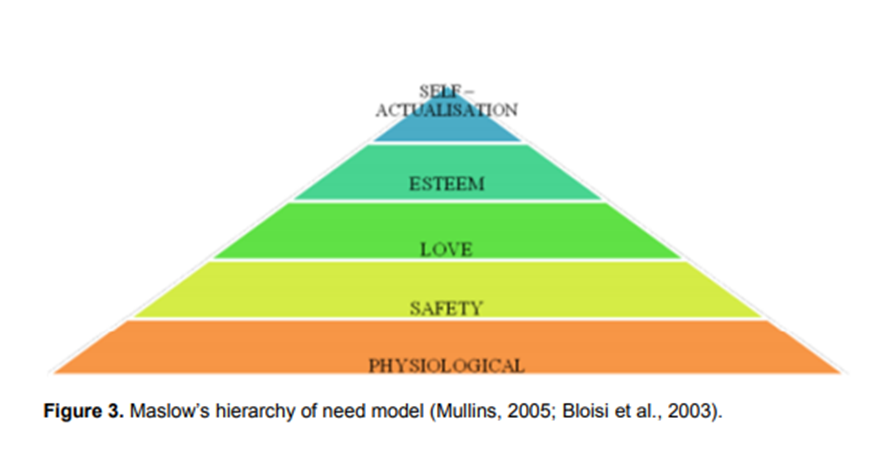
Maslow’s hierarchy of needs theory Maslow (1943) made a basic proposition that people are wanting beings. This proposition was based on the way people are always looking for more wants, and their wants are dependent on what they already have. With this, he suggested that human needs are arranged in a series of levels, a hierarchy of importance. He identified eight innate needs of man, including the need to know and understand, aesthetic needs, and the need for transcendence. However the hierarchy is usually shown as ranging through five main levels from the lowest need being physiological, through safety needs, love needs and esteem needs to the highest level of needs being self-actualization (Mullins, 2005) (Figure 3).
This theory states that when a lower need is satisfied, it is no longer a strong motivator and hence the demand for the next higher need becomes dominant and the individual’s attention is turned towards satisfying this higher need. It states that only unsatisfied needs motivate an individual (Mullins, 2005; Armstrong, 2006). Irrespective of the demand for satisfaction of higher needs, it has been established that self actualization being the highest level can never be satisfied (Armstrong, 2006).
Physiological needs: It is the basic need of life. It comprises the need for relief from thirst, hunger, physical drive, oxygen, sexual desire. (Mullins, 2005; Armstrong, 2006; Bloisi et al., 2003).
Safety needs: This includes safety and security, freedom from pain or threat of physical attack, protection from danger or deprivation, the need for predictability and orderliness. (Mullins, 2005; Armstrong, 2006; Bloisi et al., 2003).
Love: It is sometimes referred to as social needs and includes affection, sense of belonging, social activities, friendship, and both the giving and receiving of love. (Mullins, 2005; Armstrong, 2006; Bloisi et al., 2003).
Esteem: It is also often referred to as ego and includes self respect which involves the desire for confidence, strength, independence and freedom. In addition is esteem of others which involves reputation or prestige, status, recognition, attention and appreciation. (Mullins, 2005; Armstrong, 2006; Bloisi et al., 2003).
Self-actualization: This is the development and realisation of one’s full potential. Maslow saw this level as what humans can be, they must be, or becoming everything that one is capable of becoming. It is the need to develop potentials and skills, to become what one is believes he/she is capable of becoming (Mullins, 2005; Armstrong, 2006; Bloisi et al., 2003).
The hierarchy of needs theory is relevant to this study as the theory is applicable to organizational orientation and employee motivation (Greenberg & Baron, 2003). They further argue that the theory is able to suggest how managers can lead their employees or subordinates to become self-actualized. The idea implies the dual role of the theory first to organizations and second to employees on the basis that both the organization and the employees must decide on the performance of their organization, and that when employees put in their best in the service of the organization, the culture and human resource practice should also ensure that the employees’ level of needs are reflected in the values the organization holds with high esteem (Greenberg & Baron, 2003).
The cultural framework of the organization should reflect the fact that employees’ physiological and security needs are paramount; therefore, when such needs became culturally focused, performance will be improved tremendously in that organization (Maslow, 1954).
Above mentioned needs applied in IT Industries employees as well. According to the Maslow’s hierarchy of needs how can motivates with five needs others work life, for more details go through this below link
Maslow's Hierarchy of Needs - What motivates us
(Source: Maslow's Hierarchy of Needs - What motivates us, 2018)
Reference List
Armstrong M (2006). Human Resource Management Practice, Kogan Page, Pp. 251-269.
Greenberg, J., and Baron, R. A.( 2003). Behavior in Organizations: Understanding and Managing the Human Side of Work. Englewood Cliffs, NJ: Prentice.
Maslow AH (1943). A theory of human motivation. Psychol. Rev. 50(4):370-396
Maslow's Hierarchy of Needs - What motivates us (2018) [Video].Available from https://www.youtube.com/watch?v=IETlvTNWhPg&list=PPSV [Accessed on 29 November 2022].
Mullins LJ (2005). Management and Organisational Behaviour. Prentice hall. UK 7th Ed. 88(431):1052-1058.